

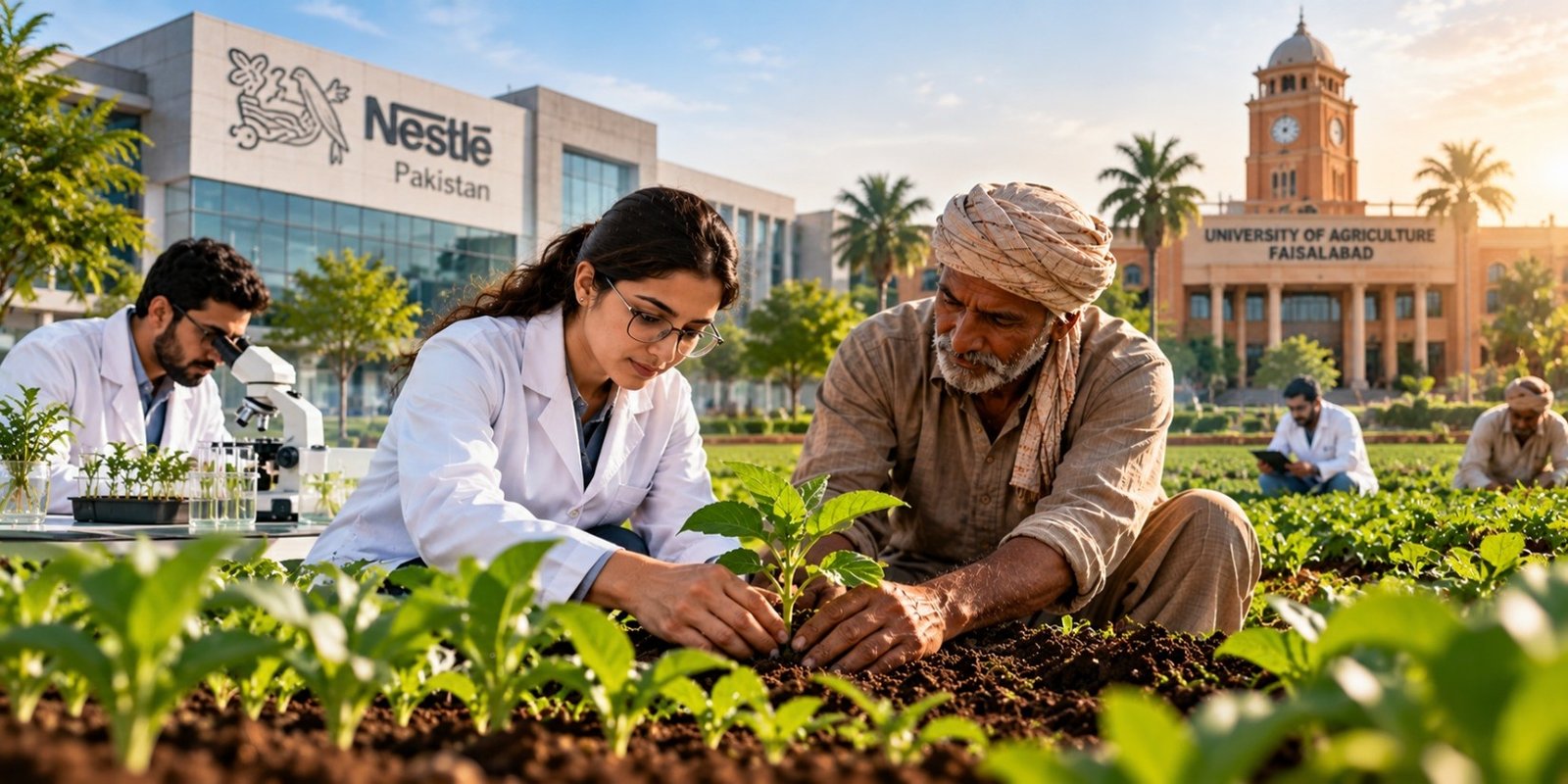
Nestlé Pakistan and the University of Agriculture Faisalabad (UAF) have strengthened their partnership to advance regenerative agriculture and sustainable food systems in Pakistan.
The two organizations signed a Memorandum of Understanding (MoU) covering sustainable agriculture, food science, nutrition, applied research and workforce development. The agreement supports Nestlé’s broader efforts to introduce regenerative agriculture across its value chain.
The partnership was formalized during a visit by Jason Avanceña, CEO and Managing Director of Nestlé Pakistan, and the company’s senior leadership to UAF in Faisalabad.
A key part of the collaboration is the establishment of the Nestlé Learning Resource Center (NLRC) at UAF’s National Institute of Food Science and Technology (NIFSAT).
According to Nestlé Pakistan, the center is intended to support knowledge sharing, research collaboration and leadership development while connecting industry expertise with young talent.
Regenerative agriculture is also central to Nestlé’s sustainability strategy. The company says its approach focuses on protecting and restoring natural resources while improving the resilience of farming communities.
Nestlé Pakistan is already working with farmers to improve soil health, water efficiency, biodiversity and climate resilience. Regenerative agriculture practices have so far been introduced across more than 125 maize, alfalfa, oats, sorghum and wheat farms in Punjab.
The company links these efforts to its global ambition of achieving net-zero greenhouse gas emissions by 2050.
For UAF, the partnership also creates opportunities for students and researchers to gain practical industry exposure and work on solutions for more resilient and sustainable food systems.
The initiative aligns with several United Nations Sustainable Development Goals, including SDG 13 on Climate Action, SDG 15 on Life on Land and SDG 17 on Partnerships for the Goals.