



Maryam, the author of this article, is an undergraduate student pursuing a BS in Computational Physics. She has served as a Student Voice Leader at her college for two years and has been actively involved in academic research and computational physics projects. Her work includes research on the influence of aircraft geometry on Radar Cross Section (RCS), developing a 2D planetary simulation to track the speed and distance of planets, and currently working on a 3D projectile motion project. She can be reached at email.
Stealth aircraft are often described as invisible to radar. They aren’t. They are simply very difficult to detect from most angles. A new study suggests that one of the most routine things a pilot does—banking into a turn—can quietly reduce that advantage.
A Plane That Looks Different from Every Side
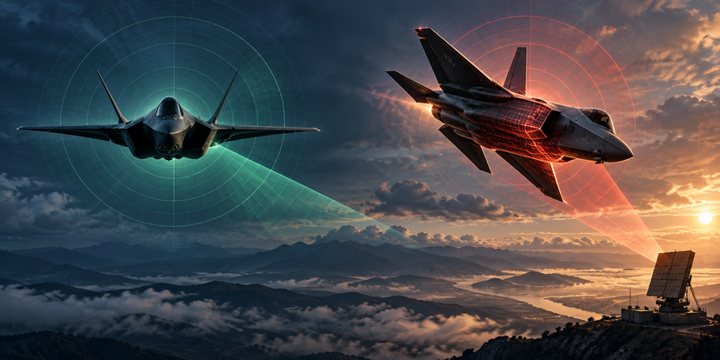
Radar detects an aircraft by bouncing signals off its surface. How strongly the aircraft reflects those signals is known as its radar cross section (RCS). A low RCS produces a weaker echo, making the aircraft more difficult to detect.
But RCS is not a fixed number. It changes depending on the angle from which radar observes the aircraft.
Imagine a disco ball in a dark room. From most positions, you may see almost nothing. But from one particular angle, a bright flash can suddenly appear.
Stealth aircraft can behave in a similar way.
In the researchers’ simulation of a flying-wing aircraft, the radar signature increased sharply around 35° azimuth. The researchers defined the surrounding region—from roughly 30° to 40°—as a high-RCS sector.
Outside this sector, the aircraft is harder to detect. Once it enters it, the probability of detection can increase sharply.
The Earlier Strategy: Sprint Through the Flash
Earlier research approached this problem with a relatively simple idea.
Early path-planning studies largely treated an aircraft’s radar visibility as constant, while later work introduced simplified geometric models. More recently, a 2023 study by Lu and colleagues recognized that real stealth aircraft can have bright and dark radar sectors.
The strategy was straightforward: when the radar’s viewing angle approaches a high-RCS sector, the aircraft makes a rapid turn to cross the sector quickly before returning toward its original course.
The reasoning is simple: less time inside a high-RCS region means less opportunity for detection.
But there was a catch.
The Missing Factor: Aircraft Banking
Those studies largely treated the turn as a two-dimensional maneuver and focused on the aircraft’s heading.
Real aircraft do more than simply change direction. They bank.
As an aircraft turns, its wings tilt relative to the surrounding environment. That changes its three-dimensional orientation—and potentially changes the angle from which radar sees the aircraft.
So, what happens when banking is included?
A Three-Dimensional Look at Stealth
Researchers led by J. Guan, writing in the Chinese Journal of Aeronautics in 2026, rebuilt the problem with aircraft banking included.
Their model tracks the aircraft’s three-dimensional orientation using what they describe as a pseudo-6DOF model, together with aircraft dynamics, an RCS database, and a radar model that estimates detection probability over repeated scans.
The researchers then compared the same flight path using two different approaches: one that treated the turn as essentially flat and another that included aircraft banking.
The difference was striking.
Under the comparison conditions, the aircraft made a 20° turn at 2g, at an altitude of 8,000 meters and a speed of Mach 0.8, while the radar was positioned 100 km away.
- Flat-turn model:83% probability of detection
- Model including banking:14% probability of detection
The flight path was the same, yet the simulated probability of detection was nearly five times higher when banking was included.
The Culprit: Azimuth Regression
The researchers attribute this effect to what they call azimuth regression.
As the aircraft banks, its orientation relative to the radar changes. An aircraft may initially move away from a high-RCS sector, but the changing geometry can shift its relative azimuth back toward that sector.
Imagine stepping away from a spotlight, only for the floor beneath you to tilt and bring you back into the beam.
That is essentially the problem the researchers identified.
The Proposed Solution: Turn Hard, Then Turn Soft
The study found that the aircraft’s load factor, which describes how aggressively it is maneuvering, plays an important role.
A harder turn generally requires a greater bank angle, while the bank angle influences azimuth regression.
The researchers found that different stages of the maneuver benefit from different load factors.
Turn Hard Early
Higher load factors—around 2g—during the first two turns allow the aircraft to move through the high-RCS sector quickly.
The objective is to minimize the amount of time spent in the vulnerable region.
Turn Soft at the End
The final turn presents a different problem.
The researchers found that a load factor of approximately 1.064g produces a much smaller bank angle. This helps reduce azimuth regression and prevents the aircraft’s relative azimuth from moving back into the high-RCS sector.
The Final Turn Angle Matters
The geometry of the final turn also proved important.
According to the study, a 40° deflection angle was the smallest angle that fully cleared the high-RCS sector while delaying the return toward it.
Smaller angles failed to clear the sector, while larger angles produced greater azimuth regression.
Testing the Improved Trajectory
The researchers then tested the improved trajectory pattern under different simulated conditions, including different radar powers, altitudes ranging from 2 to 10 km, and speeds between Mach 0.4 and Mach 0.8.
Across these simulated conditions, the revised trajectory consistently produced a lower probability of detection than the earlier strategy.
Important Limitations
This remains a computer simulation, not a flight demonstration.
The study examines a particular aircraft configuration and radar-detection scenario, while real aircraft encounters involve additional complications.
The model does not fully account for factors such as sideslip or interactions involving multiple radars.
The authors therefore suggest further research involving real flight testing, different radar types, more detailed aircraft modeling, and intelligent methods such as reinforcement learning that could adapt flight paths in real time.
Stealth Is Also About How an Aircraft Moves
Stealth is not only about how an aircraft is designed. It is also about how it moves.
A jet can have an impressively low radar signature from one direction and a much larger signature from another.
That means a flight path that appears safe on a flat map can behave very differently once the aircraft’s wings tilt.
The study highlights an important point: the maneuver intended to keep a stealth aircraft hidden can, under certain conditions, bring it back toward the radar’s most vulnerable viewing angle.
In other words, staying stealthy may depend not only on where an aircraft flies, but also on how it turns.
Source:
- Guan et al., “Mechanism analysis and strategies for high-RCS sector avoidance in stealth aircraft during turning maneuvers,” Chinese Journal of Aeronautics, 2026.
DOI: 10.1016/j.cja.2026.104175. The study is open access.